

Cybersecurity budgets are rising in 2026, but smart allocation is what drives real ROI. Here’s how to make every dollar count.
As we head into 2026, cybersecurity spending is expected to surge globally, with forecasts projecting a 12.5% increase to reach approximately $240 billion. But more money doesn’t always mean more protection. The real challenge for Australian enterprises isn’t just securing bigger budgets, it’s proving that those investments deliver measurable risk reduction and business value.
Here’s how to strategically allocate your 2026 cybersecurity budget to maximise ROI and resilience.
1. Reframe ROI Around Security Yield
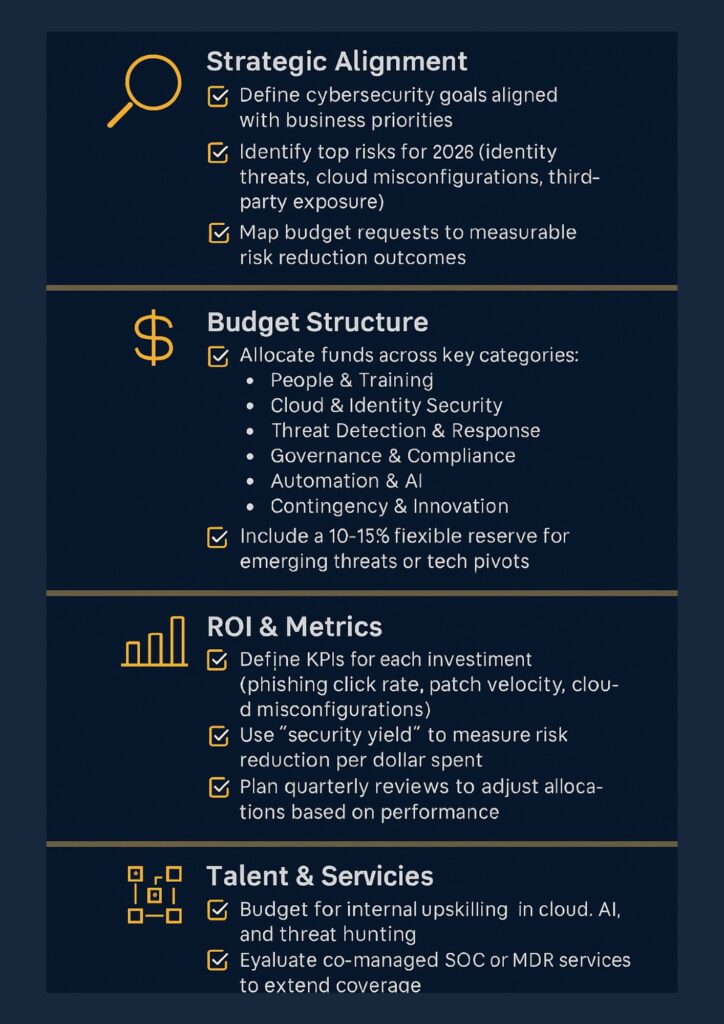
Traditional ROI metrics don’t always translate in cybersecurity. Instead, leading CISOs are shifting toward “security yield”, the amount of risk reduced per dollar spent.
Example: Investing in cloud visibility tools that reduce over-permissioned accounts by 70% offers a clearer return than vague improved monitoring.
Tip: When presenting to the board, link each investment to a quantifiable risk delta (e.g., “This tool reduces our attack surface by X%”).
2. Balance People, Process, and Technology
People remain the largest line item, averaging 25% of total security spend. But adding headcount doesn’t always scale capability.
- Smart move: Consider co-managed SOCs or MDR services to extend coverage without inflating payroll.
- Upskill internally: Allocate budget for reskilling programs in cloud security, AI governance, and threat hunting.
3. Prioritise Cloud and Identity Security
With hybrid work and SaaS adoption accelerating, cloud and identity remain top attack vectors.
- Allocate funds to:
- Cloud posture management (CSPM)
- Identity threat detection and response (ITDR)
- Zero Trust architecture implementation
Example: A Sydney-based fintech reduced lateral movement risk by 60% after implementing conditional access and just-in-time admin privileges.
4. Invest in Automation and AI, But With Guardrails
AI-driven tools can reduce alert fatigue and accelerate incident response, but they must be deployed responsibly.
- Budget for:
- AI-powered threat detection
- Automation of repetitive SOC tasks
- AI governance frameworks to assess model risk and bias
Tip: Use automation to augment, not replace human analysts.
5. Fund Continuous Risk Assessment and Third-Party Assurance
Supply chain and ecosystem risks are top concerns for 2026.
- Key allocations:
- Third-party risk management platforms
- Continuous controls monitoring (CCM)
- Penetration testing and red teaming
Example: A logistics firm in NSW uncovered critical vendor vulnerabilities through a third-party audit, preventing a potential ransomware breach.
Final Thought: Budget for Agility, Not Just Defence
Cyber threats evolve fast your budget should too. Build flexibility into your 2026 plan to respond to emerging risks, regulatory changes, and tech shifts.
- Create a 10–15% contingency fund for unplanned but high-impact investments.
- Track metrics quarterly to reallocate based on performance and threat intelligence.
By aligning your cybersecurity budget with business outcomes and measurable risk reduction, you’ll not only protect your organisation but you’ll also earn the board’s trust and future funding.
Budget Checklist
More from this months newsletter >

How to Get the Most Out of Your Security Provider
How to Get the Most Out of Your Security Provider A strong security provider can […]

Australian Data Breaches: Lessons from Recent Incidents
Lessons from April and May’s Australian Data Breaches April and May brought a noticeable increase […]

Advanced Phishing Emails: Real-World Example and How to Stay Protected
Advanced Phishing Emails: Real-World Example and How to Stay Protected Phishing continues to be one […]
Spotlight Feature Devo: Real-Time Security Analytics
Spotlight Feature Devo: Real-Time Security Analytics Security leaders are facing mounting pressure with limited resources […]